Last Updated: November 1, 2026
Quick Summary
The best harley-davidson for beginners is a lighter, lower-displacement model with predictable power delivery, such as the Street 500 or 750. Weight, seat height, and throttle response matter more than looks, so confirm you can flat-foot the bike and hold it up before you buy.
The best Harley-Davidson for beginners is a lighter, lower-displacement model with predictable power delivery. Weight, seat height, and throttle response matter more than the paint job when choosing a first bike.
A beginner rider should think in three numbers: wet weight, seat height, and engine displacement. Get those right and the rest of the decision gets much easier.
Ask about the lightest Harley-Davidson motorcycle and most salespeople point to the smaller Sportster variants. Light weight is the single biggest confidence factor for a first motorcycle. A lighter bike is easier to hold at a stop, easier to push out of a parking space, and far more forgiving during low-speed control drills.
Harley-Davidson’s own beginner guidance recommends matching the motorcycle to the individual rider rather than chasing a spec sheet, per Harley-Davidson’s beginner motorcycle guide. We agree, with one caveat: weight is the spec most new riders underestimate.
The 750cc class is the sweet spot for many new riders. The Street 750 and Street 500 are generally regarded as entry-level motorcycles.
Dealers in our region describe mid-size, low-seat-height bikes as the practical choice for beginners, noting that a rider should be able to flat-foot the bike at a stop and pick it up if it drops, per Cajun Harley-Davidson’s first-bike guidance. If you want to see a light, beginner-friendly Sportster in person, you can browse a used Iron 883 to compare seat height and weight against your own inseam.
Most beginner guides recommend a model and stop there. The more useful exercise is to compare the entry points on the numbers that actually decide whether a bike fits you: wet weight, seat height, engine displacement, fuel capacity, and how the power arrives. The table below is a starting framework, not a verdict, rider size, inseam, and confidence change the answer.
| Model Family | Displacement | Typical Wet Weight | Typical Seat Height | Fuel Capacity | Beginner Strength | Watch Out For |
|---|---|---|---|---|---|---|
| Street 500 / 750 | 500-750cc | Roughly 480-510 lb | About 28 in | Around 3.5 gal | Light, low seat, easy low-speed handling | Limited touring comfort, discontinued in recent model years |
| Iron 883 | 883cc | Roughly 560-570 lb | About 25-26 in | Around 3.3 gal | Very low seat height, simple controls, huge used market | Vibration at highway speed, modest power |
| Sportster 1200 | 1200cc | Roughly 570-590 lb | About 26-27 in | Around 3.3 gal | More torque, still manageable | Heavier, less forgiving of clumsy throttle |
| Nightster | 975cc | Roughly 480-500 lb | About 27-28 in | Around 3.1 gal | Modern brakes, stable chassis, lighter than it looks | Higher price, more power than a true novice needs |
| Softail Standard | 107ci | Roughly 650-670 lb | About 26-27 in | Around 5 gal | Comfortable, stable, good for taller riders and longer rides | Heaviest of this group, hardest to pick up if dropped |
Read the table in this order. First, seat height against your inseam: you want both feet flat on the ground at a stop, not tiptoes. Second, wet weight against your strength: a bike you cannot hold up on a slight incline is a bike you will eventually drop. Third, displacement and power delivery: a smaller engine with smooth throttle response teaches clutch and cornering habits faster than a torque-heavy one.
Two things this table cannot show: how the bike feels under you, and how the clutch engages. Those only come from a test ride. Sit on at least three models before you ride any of them, and ride at least two back to back so you can feel the difference in weight and reach rather than guess from a brochure.
A low-mileage used Sportster or Softail Standard is often a practical choice for a first-time rider. You can browse used Harley-Davidson Softail Standard inventory to see what is available. Buying used is how many first-time riders get into a Harley without stretching a budget.
Start with the discontinued entry-level models. When buying any used bike, ask specifically about service history and whether the bike was previously used for rider training, since training bikes often see clutch and low-speed wear.
The Sportster family is the deepest used market. Ask the dealer which model year the bike is and what changed that year rather than assuming all years are equivalent.
A used-bike inspection should cover these specifics:
Ask the dealer directly what inspection the bike went through and what warranty comes with it. If a Softail Standard is on your shortlist, you can view a used Softail Standard listing to see how a specific bike is presented, including the details a careful buyer should ask about.
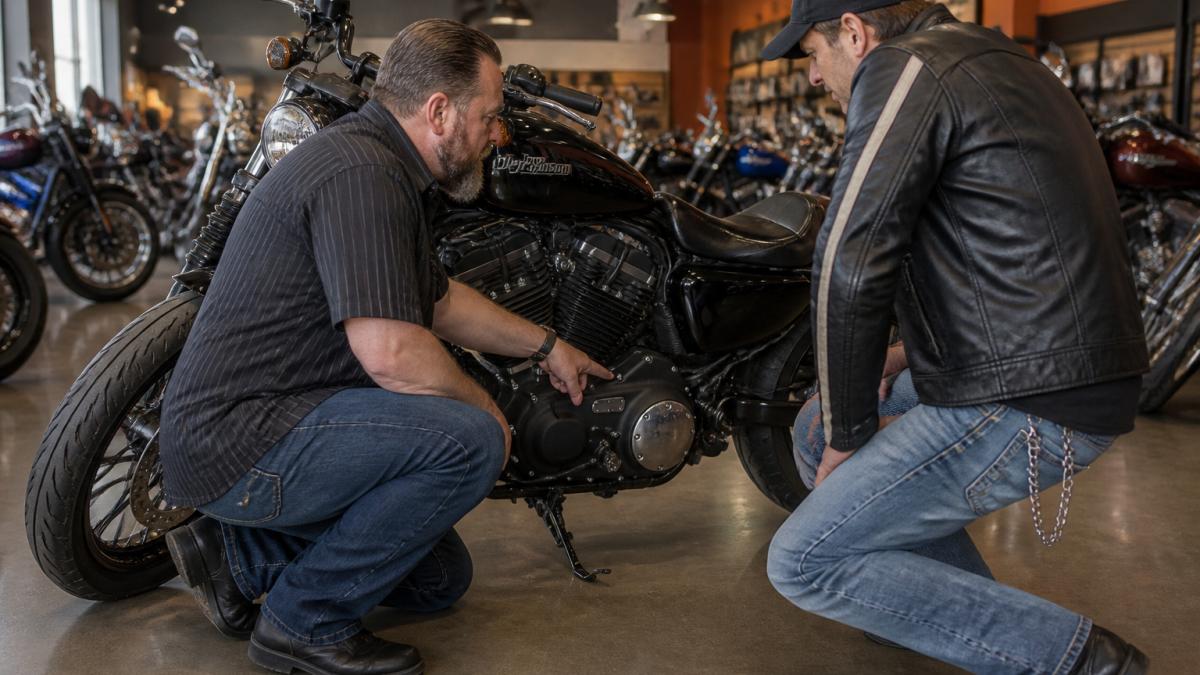
Choosing a first Harley comes down to fit, then budget, then style, in that order. Get fit wrong and nothing else matters.
Work through this checklist before you commit:
Total cost of ownership is the gap most buyers miss. Purchase price is only the first number. Add insurance, gear, tires, and scheduled service, and the annual figure looks different from the sticker. Ask for that breakdown in writing.
A common mistake is buying on looks alone. The second most common is skipping training because the bike feels easy in the parking lot. It isn’t, yet. The Motorcycle Safety Foundation runs beginner courses that cover exactly this.
If you are still deciding where to buy, here is where to buy a Harley-Davidson locally, with the selection and guidance a first-time buyer needs.
A test ride settles what no spec sheet can. Learn how to book a Harley-Davidson test ride at Grand Canyon Harley-Davidson. You will feel the weight, the reach to the controls, and the throttle response in the first hundred feet.
Riding position and comfort matter as much as power. Sit on the bike, put both feet down, and check the reach to the bars before you ride it. If it feels like a stretch, it is the wrong bike, no matter how good it looks.
A 750cc cruiser like the Street 750 can be a reasonable first bike if you respect the throttle and take a rider training course. Still, practice in parking lots and empty roads before heading into traffic. Many riders start on smaller displacement bikes, but the Street 750 remains a popular entry point for those who want a little extra highway capability.
Lighter weight makes low-speed handling and maneuverability easier for new riders, so compare the weight and seat height of the models you are considering. Sit on one at a dealer to confirm the reach to controls feels comfortable.
Both paths work, but each has trade-offs. A used Harley like a Sportster 883 often costs less and lets you learn without worrying about the first scratch. Inspect maintenance records, check tire wear, and ask about any warranty. A new bike gives you the latest safety features and a full factory warranty. Ask any dealer about the inspection process and warranty coverage before you commit to a used bike.
Start with your inseam and seat height: you want both feet flat on the ground at a stop. Then consider weight, engine displacement, and your riding goals. A lighter bike like the Nightster or a used Sportster 883 is easier to handle in parking lots. Sit on several models, take a test ride if you are licensed, and budget for gear, insurance, and maintenance. A dealer visit lets you compare riding positions and ask questions before you buy.
The hardest part of buying a first Harley is not picking a model. It is knowing which questions to ask before you sign. Grand Canyon Harley-Davidson can help you work through fit, model comparison, and what a used bike actually includes, with an extensive selection of new and used Harley-Davidson motorcycles and a team that guides first-time buyers through the decision rather than around it. Get started with Grand Canyon Harley-Davidson and find the bike that fits you.
While great effort is made to ensure the accuracy of the information on this site, errors can occur. Please verify all pricing and installed equipment information with a customer service representative. This is easily done by calling us or visiting us at the dealership.
We improve our products and advertising by using Microsoft Clarity to see how you use our website. By using our site, you agree that we and Microsoft can collect and use this data. Our privacy statement has more details.

Save your favorite vehicles for later viewing on your desktop or mobile devices.
Keep track of all the vehicles you've viewed for a better car shopping experience.
Narrow your search by comparing your favorite vehicles.


